
The iPhone is very useful, but they also are incredibly addictive. I spend most of the time on Youtube Instagram, iMessage, and FaceTime. I enjoy watching basketball highlights and watching any type of videos that are recommended for me. When it comes to iMessage I’m in a group chat with my friends where we send random pictures and videos we see on social media. For Instagram, I’m a frequent user I spent most of the time on entertainment on pages like The ShadeRoom and Akademics page finding out news and new music. The app I enjoy the most is FaceTime because I like to see who I’m taking to face reaction. Also, I used this app called Bleacherreport that focuses on sports and sports culture. I used that app every day. It gives me any alerts of my favorite teams in sports. it keeps aware of what’s going on in sports. I think my phone keeps on track of everything I like easily. But still makes me lazy because I depend on my phone so much. Overall, I wouldn’t last a day without my phone because I like to be informed of news and it helps me interact with my family and friends in a faster way.
Brieya Walker 9/11/2018 WEEK 3 Marie Battiste, Print Culture and Decolonizing the University
For this weekly response I’m reflecting on Print Culture and Decolonizing the University, written by Marie Battiste. This reading shares the history between Euro-Christian travelers/missionaries and the indigenous peoples. These travelers and missionaries completely transformed and tried to erase the history of their aboriginal literacy and claimed the Indians to be illiterate because they didn’t agree with or understand their ideographic and symbolic literacy. Aboriginal literacy relates to the spiritual, practical, public functions of symbolic literacy which includes their pictographs petroglyphs, notched sticks, ideographs, and wampum. I believe this reading successfully showed that any literacy process can work as long as people have a use for it because it shows how critical it was to many Indigenous societies. In addition, it mentions that many of the history taught regarding the indigenous people and the Europeans is very one sided and I one hundred percent agree with that. Reading this automatically made me think about a passage I read in an English class called American Identities. The passage basically spoke about how Indians were portrayed as savages, how they were always killing each other, and their excessive alcohol use, which all were true but we’re not taught why this occurred. This week’s reading made me think of this because this is another example of how the Europeans portrayed the Indigenous to be illiterate but in fact their culture influenced their own creations in several ways.
Marie Battiste. “Print Culture and Decolonizing the University: Indigenizing the Page: Part 1.” The Future of the Page . University of Toronto Press, 2004.
Week 6: Technology and War and Cybernetics, oh my!
For this weeks post I chose to read “As We May Think” by Vannevar Bush. Bush addresses problems that he believes scientists should be paying close attention to. Almost seeing the future in technology he raised the question of how machines can help our thinking process.
For example, “it is readily possible to construct a machine which will manipulate premises in accordance with formal logic.” Beyond the logic of the mathematician, lies the application of logic in everyday affairs, ”we may someday click off arguments on a machine with the same assurance that we now enter sales on a cash register.”
NYPL Oral History project: Alassane D.
For my NYPL oral history projected I looked at a conversation between the interviewer Susan Darcy and Louisiana native Donald Trammel. The purpose of this project is to help us gain experience on how it is like to transcribe an audio recording. Audio recordings are a form of media that is all based on audio, but with the help of transcribing the audio which is to put it into words, it helps us to search a certain part of the dialogue through the words rather than look over the audio recording repeatedly. As I figured out hearing the audio multiple times to transcribe it the painstaking work to put it into words helps. It is also useful to those people who are deaf so they can’t hear the world around them.
I had to find a audio that had little to no amount of work done to it which is why I choose Donald Trammel story. The process itself of transcribing was tedious. The main reason why is mainly due to the functionality of the website. First of all to play the clip was difficult because it is impossible to pinpoint where exactly where u wanna start in the beginning so it is either you start straignt from the begining at 00:00 or 1:15 nothing in between. But after that, you can pick where ever you want to start.
In the section of the site where we type down what we hear I found it difficult becuase I wanted to make sure where exactly the time and the audio synced in. I wanted to make sure everything fits exactly as in the audio. There are sections of the audio that are clear to understand and some that are not as easy. One reason may be due to the recording equipment not being close their mouths or the accents they speak in. Donald clearly has a southern accent and some words to me arn’t audible. One example I can’t point out is what his previous job was. On the site, there is generated transcribtion but some things are not correct. The generater can’t pick up on slang such as reefer I noticed. I am familar with the term so I know what he means, to the generator it may see the word as giberish and fills it in with the closest word.
I would probly do this process again but with better softwear and better headphones to help me hear more clearly.
Michael Farias blog post for November 27
For this blog post I chose to write about to “Missed Connections” by Safiya Umoja Noble. This article talks about important things in life such as the Internet. The Internet is great but it is also making people lazy and sometimes even stupid. With the Internet at our disposal we can find out anything we want without having to do much work, which makes us lazy. This in a way is taking away the value of education because everything you need to learn can be found on the Internet. Noble talks about how the search engine of a computer can exploit women. She says that you could be looking up something about the history or culture of women and pornography will be the first thing that comes up. You weren’t looking for this but it is what your search engine gave you. That is not okay and needs to change.
Michael Farias blog post for November 20
For this blog post, I chose to write about “Database as a Symbolic Form” by Lev Manovich. In the article Lev talks about the term database and its symbolic meaning. He says that computer science defines database as “a structured collection of data” (Manovich 1). This is basically where everything that is done on the Internet is stored. He says that all of this data is stored in a specific order according to a hierarchy. This is something (like everything else on the Internet and media) that is overlooked. We never think about where and how everything that we put on a computer goes and is stored.
Alassane D. Week #1
After I was done reading “Cybernetics and Ghost” I thought about the process of creating a story and presenting it to an audience. Near the beginning of the semester, everyone in the class had to stand up in front and speak of a story that was never written down. In other words, our chosen story must never be written down but rather spoken orally. Which ties into the article which talks about ways of telling a story. I decide to speak about the story of how I got my jaw locked in place while I was in class back in High school. picked this personal story because of the shock value it brings to anyone who hears it. The idea of having your jaw locked in place is completely unusual to most people and rarely would anyone go through it. Even when I was in the hospital everyone there who are professionals or professionals in training have never seen or heard of my tempory condition. The story also follows the prompt, I have never written down the story anywhere but I have spread the existence of the story through word of mouth which is one the ways to tell a story.
As I stood up to tell the story I had to put myself in the mindset of a village chief or elder that wants to speak. In the article, the author brings up storytellers in tribes that speak of stories to spread knowledge and stores about hunting creatures in the wild, personal life and family history.
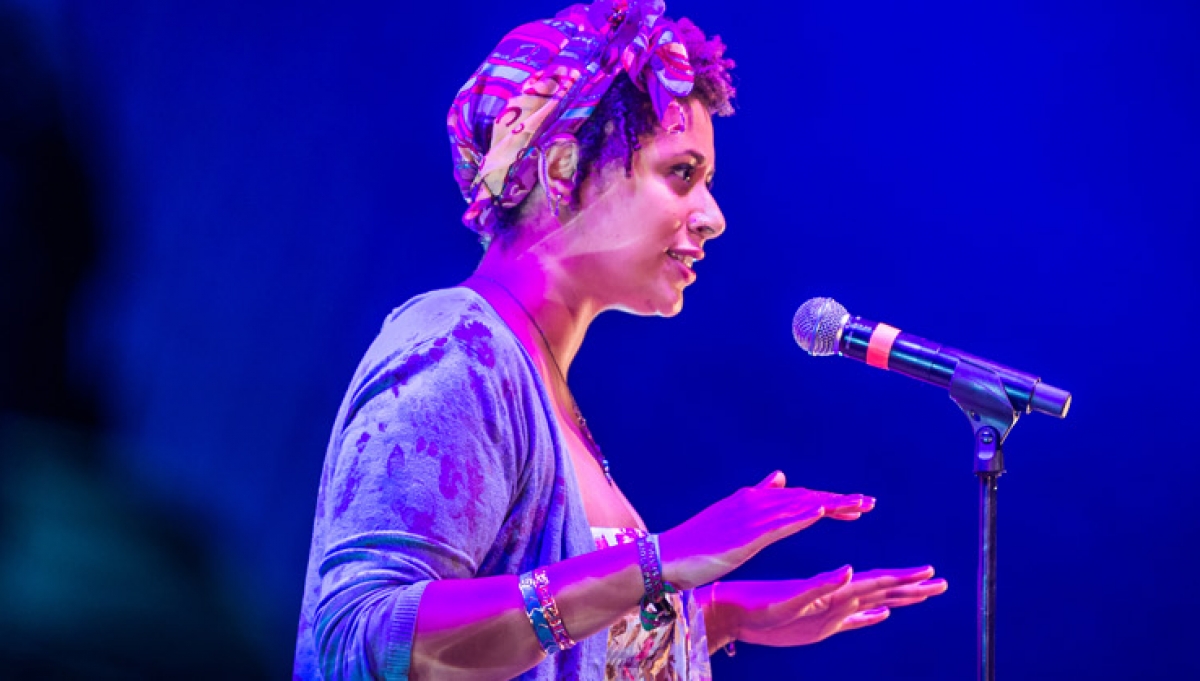
http://www.roundhouse.org.uk/about-us/artistic-programme/spoken-word/
Frida Barolli Blog post week #13
For this week reading, I am focusing on “Is Google Making Us Stupid” by Nicholas Carr. Before I even began to read the article, I said to myself is it really making us stupid? I am on google most of the time researching for school, finding a recipe to cook or bake, looking up things that I need, searching for basically everything and anything. I honestly feel like google is making us stupid and isnt making us stupid. Google is a major search engine that provides you with tons of information right at your finger tips. Why do you need to think back when you can just research something within seconds. But, then again this is bad. This doesnt help us use our memories to recollect information that we know. Our memories are literally disconnected because of google. I can’t read books through a kindle or computer, I can’t focus, I get lost, i don’t take it serious because most of the time the computer is used for fun or school. I need to have a hardcopy of a book in order to read and understand and process the information. I kind of miss the times where we had to look up words in a dictionary or read text books in order to get information. Technology is good and bad.
week 2
in the article orality and literacy by walter ong, the author talks about how some technology is actually having a negative effect on us. in my opinion, i believe technology is a double edged sword. on one end its good, on the other its bad. technology has expanded our thinking and development as human beings. our advancements allowed us to live longer, express ourselves differently, and even interact with others differently. technology has advanced the world and connected countries to each other, who would otherwise not be connected. we were given technology in its infant form, from print, telegraphs, and telephones. we affirmed our reliance on the various technology by constantly using and developing our technology. we never questioned how technolgy would affect us in a negative way, but we always highlighted the positives. we began to rely to heavily on our modern technology which lessened the strength of our human nature. for example, people use their phones to schedule their days and important information, which i believe made our memory less powerful as we have our phones. television has made us more lazy as we sit in front of it for hours on end learning nothing in the process. social media has lessen our confidence in ourselves as we explore and envy other peoples lives, while being extremely critical of our own. technology in some forms changed the whole human experience. our dependence on technology in our daily live is similar to a drug, and if somehow someway technology as we know was magically erased, well see a lot of tech heads suffering from withdrawal. Myself included.

