Week 11 Victor Afolabi: Reading Alone and Together

“NEW AGIPPA FILES”

The original story. (c) 1992

Snapchat went viral, then Instagram copied and invented stories, then facebook joined in since their instagram’s parent company.

Snapchat went viral in 2015 and it has since became possible for people to learn more details about your location, your current status via the live option, and transparency became something we adapted to on a daily basis since these documents automatically deleted in 24 hours.


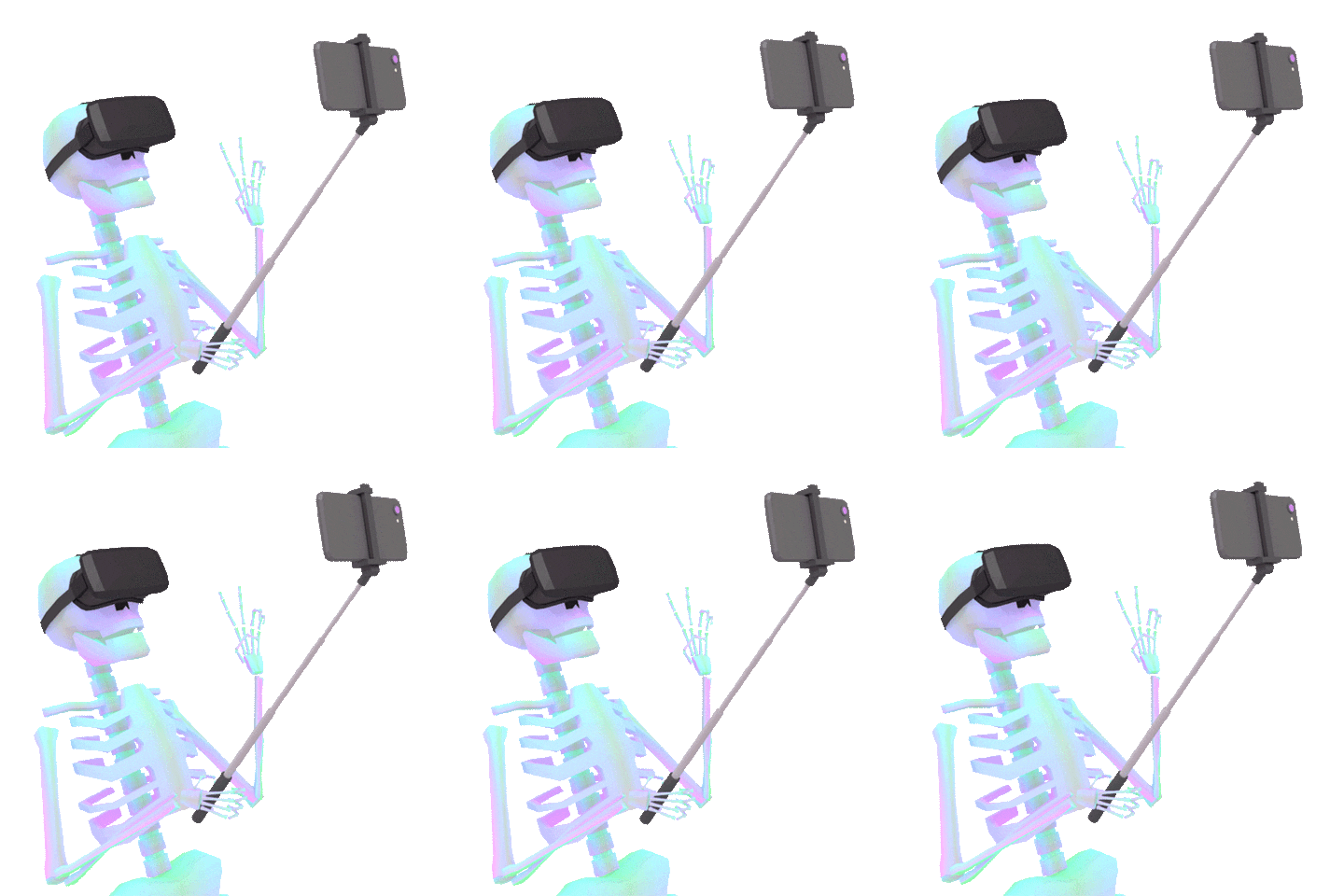
The rates of selfies skyrocketed as people bought selfie-sticks that summer(2015). It became a trend because tourists made it a cool accessory for recording their videos as they vacation especially with family spent in New York City.


Brieya Walker 10/6/18 WEEK 6 Vannevar Bush, As We May Think.

For this week’s blog post I chose to reflect on Vannevar Bush’s As We May Think from The Atlantic Magazine. This article discusses the use of science and the new gadgets and useful tools that science lead to the creation of. It always states that when referring to science “there is a growing mountain of research”(Bush, 1945) I like section two of thos article where it discusses photography and how the progress of photography is never going to stop because I agree.  I always relate everything back to my personal experiences so it made me think about how growing up I remember my mother using the camera’s that needed film and we couldnt see what the picture looked like until we got them developed. Then as time went by we upgrade to digital cameras and needed SD cards and we had to print the pictures out. This is when apple started with ipods and the first iphones and the camera quality wasnt as good. Now our iphones takes the best pictures and we can edit them right on our phones. There’s the canon and other top notch brand of cameras that cost a fortune but take great quality pictures. I think for the last decade science and photography definitely evolved more than we expected and it happened quickly.

Bush, Vannevar. “As We May Think.” The Atlantic, Atlantic Media Company, 13 Mar. 2018, www.theatlantic.com/magazine/archive/1945/07/as-we-may-think/303881/.


Jessica Colasacco Week 13

This week, I decided to focus on the article “Missed Connections” by Safiya Noble. I always knew that google used an algorithm to filter their searches, but I never truly understood what the algorithm was or to what extend they used our own data against us. Noble states that “Google applications like Gmail and social media sites like Facebook track your identity and previous searches to unearth something slightly different. Search engines increasingly remember where you’ve been and what links you’ve clicked in order to provide more customized content,” which scares me (Noble 39). My searches somehow count against me. Although it should be seen as a good thing, it makes me feel extremely uneasy for some reason. I always knew that someone’s trace on the internet is there forever, but I never expected a site to you my own personal search history to filter what I can and cannot see. It does make sense, since it shows you things that it thinks you are looking for, but what if that is not what I am looking for? I think open internet access, that does not use your past histories, is what should be used in sense of search engines.

Jessica Colasacco Week 12

The reading I focused on this week was Michael Mandiberg’s The Social Media Reader. In this book, he researches the new definition of the audience and the how social media has changed people’s roles in all definitions of life. I have not thought about this before and this was extremely interesting to me. The part that stuck with me the most is when he he says “the people formerly known as the audience are those who were on the receiving end of a media system that ran one way, in a broadcasting pattern, with high entry fees and a few firms competing to speak very loudly while the rest of the population listened in isolation from one another—and who today are not in a situation like that at all.” This seems crazy to me. Media was supposed to allow people to have control of what they wanted to hear about and how they wanted to communicate, but instead, a few corporations now own the entire media business and people are only allowed to listen to what they want broadcasted. For example, the Sinclair Media Group owns thousands of news organizations around the country, and if they get a message from the main branch saying they have to broadcast something that night, they have to since they are technically owned by Sinclair. To me, this is not a fair way to conduct news. News is supposed to be objective, and this is not objective news reporting in the slightest.

Jessica Colasacco Week 11

This week, I focused on Rita Raley’s TXTual Practice. This text was extremely interesting to me because I truly love art exhibits and interactive text events are definitely a new form in the art world, especially in a society where you can claim anything is art. This one quote stuck out to me the most: “Interactive text events invite collective attention, not in a pernicious fashion, but rather in the sense of propagandistic manipulation. The group or collective (audience) is held together by the transmission of affect; the unity is thus to be understood as functional, operational” (Raley 25). This statement is extremely true of text art installations. In a sense, they can be considered propagandistic manipulation. While watching the installation, people are completely entranced by what the artist is showing, and whether you agree with what he/she is saying or not, the audience is definitely memorized. It is definitley something worth looking into during this time period, since art installations are a huge part of today’s art scene. Even right now, thousands of people are in Miami for Art Basel, which is a huge text art installation.

Jessica Colasacco Week 10

The reading I focused on this week was Brian Winsotn’s Media Technology and Society. Both these readings were interesting because they focused on the development of the radio, which is hard for someone my age to fathom. With the numerous amount of technologies available now, it is hard to imagine a time when the radio was the biggest development. Winston states, “the radio system that swept the world in the early 1920s was capable of considerable improvement and the failure to introduce refinements can be considered another element of suppression” (Winston 78).  To me, I can barely even try to understand what the world would have looked like when the radio became a technology that anyone could use. I can barely imagine a world in which I could not talk to my parents or brothers whenever I liked. These people had no idea of knowing what was going on across the country, unless they received a telegraph of an important incident. If not, they had to wait about two whole business days for the news to reach where they were and another day for the newspaper to print it out in a story and publish it. Thinking about this now, I am in complete shock. I now am able to know about a natural disaster that has taken place in Japan almost instantly. People back then would have had to wait almost a week to know that. Something like this makes me extremely grateful for technology and its ever changing ability.

Jessica Colasacco Week 4

This week, I focused on Marshall McLuhan’s Understanding the Media: The Extensions of Man.  He is known for being one of the grandfather’s of media so his interpretations are important to readers. He says “this fact merely underlines the point that ‘the medium is the message’ because it is the medium that shapes and controls the scale and form of human association and action. The content or uses of such media are as diverse as they are ineffectual in shaping the form of human association.” In this quote, he is trying to remind readers that the medium is the message, something that was not viewed this way. The medium, which can be a book, TV report, or tweet, is what shapes and controls the scale and form of human association and action. If the message is in a book, it will be received extremely different than a message that is in a text. McLuhan is trying to remind people that the medium is just a device getting the message across, but the medium plays a bigger role in the actual message then people would like to believe.

Sources:

McLuhan, Marshall. Understanding Media: The Extensions of Man. McGraw Hill BookCompany. New York, New York. 1964.

Jessica Colasacco Week 3

This week, I focused most on D.F. McKenzie’s article “The Sociology of the Text.” As someone who claims to be an avid reader, I truly enjoyed this specific article. It clearly outlined how a book and the words that are put into the book differ and make a statement about the world itself. The one line that really stuck out to me was “the book, in all its forms, enters history only as an evidence of human behavior, and it remains active only in the service of human needs.” She is saying that back then, books played a major role in communication. It allowed different parts of the world to communicate effectively with one another, since word of mouth would be hard to travel. Today, books only exist as a form of entertainment. They provide people with an escape from their real lives; for a quick moment, they are able to envision there lives as the fictional character’s. For someone who reads, I completely agree with her statement.

Sources:

McKenzie, D.F. “The Sociality of a Text: Orality literacy, and print in early New Zealand”. The Library. Vol. s6-VI, Issue 4, 1 December 1984, Pages 333-365.

Jessica Colasacco Week 1 Post

For week one,, I read “Cyborg Manifesto” from Donna Jeanne Haraway. The quote that stood out to me read “The cyborg is a matter of fiction and lived experience that changes what counts as women’s experience in the late 20th century. This is a struggle over life and death, but the boundary between science fiction and social reality is an optical illusion” (Haraway 149). This specific quote has a lot to decipher. For one, she is stating that a cyborg has the ability to change what counts as women’s experience in the later 20th century. In order to make that claim, she must believe that a cyborg is seen as higher socially ranked than a woman in a way. She also claims that the boundary between science fiction and social reality is an optical illusion. Does that mean that science fiction is becoming social reality? Does the cyborg help eliminate that boundary? It is hard to imagine a cyborg outside the realm of a robot, but there could be cyborg’s actively taking part in society, but we are too oblivious to notice it is a cyborg.


Sources:

Harawy, Donna J. Simians, Cyborgs, and Women: The Reinvention

of Nature.  Routledge. New York. 1991.

Brieya Walker 11/6/18 WEEK 11 Elizabeth McHenry, “Forgotten Readers: Recovering the lost history of African American literary societies.”

This week’s reading Forgotten Readers: Recovering the lost history of African American literary societies, written by Elizabeth McHenry discusses the creation of women clubs in the late 1800’s  and early 1900’s for black women.  During this time there were limited opportunities for black women to educate themselves in a formal academic setting. These women clubs served as an alternative an setting for them to practice the skills they needed to confidently enter public and organizational life. These women’s primary social interests were providing welfare services, building community institutions, defining the position of black women, and protesting against racial injustice.  Black women seen their accomplishments of self education and self improvement as equivalent to material accomplishments. (the outward signs of successful endeavors for the public good) They also wanted to be apart of the conversation for potentially effecting change.  In addition, these club meetings were also beneficial in contributing to the public realm because they helped with practical skills learned and helped with building confidence for these women from the educational programs that the club meetings. These women clubs focused on reading, conversation, and mutual support. I appreciated this reading because there aren’t a lot of readings that explain African American women involvement in literary societies.


Elizabeth McHenry. “Forgotten Readers: Recovering the lost history of African American literary societies.” The Book History Reader. eds. David Finkelstein, Alistair McCleery. Routledge, 2006.