Anesiya Rivera Week 7

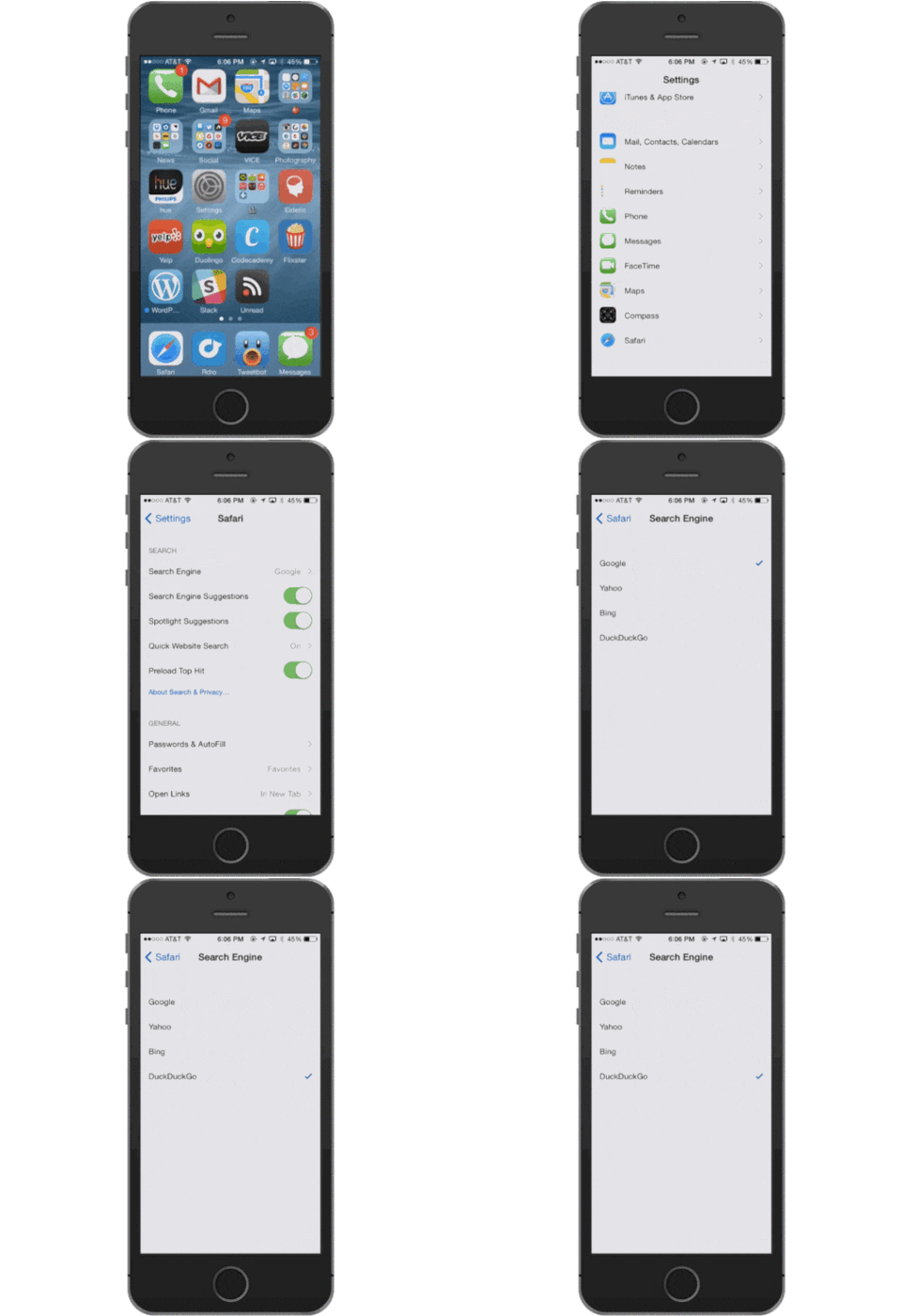
As we read further about how technology has advanced and became part of society’s everyday living, the reading looks at how technology should be organized or how the information on technology is organized, the way I look at this is the iPhone for example, an ever advancing device. That stores our everyday information. We have hundreds of apps that allow us to organize our time, scheduled our events , travel, communicate with others, shop online and now i store with Apple Pay. We literally have our whole lives stored in one device. Our bank accounts doctor appointments, even our work. As I think more into it, we HAVE to even pay for more storage ! For our music pictures, documents the more we need to store the more we have to pay !


Giphy.com

chapter two proposal for universal electronic publishing

 

Anesiya Rivera Week 6

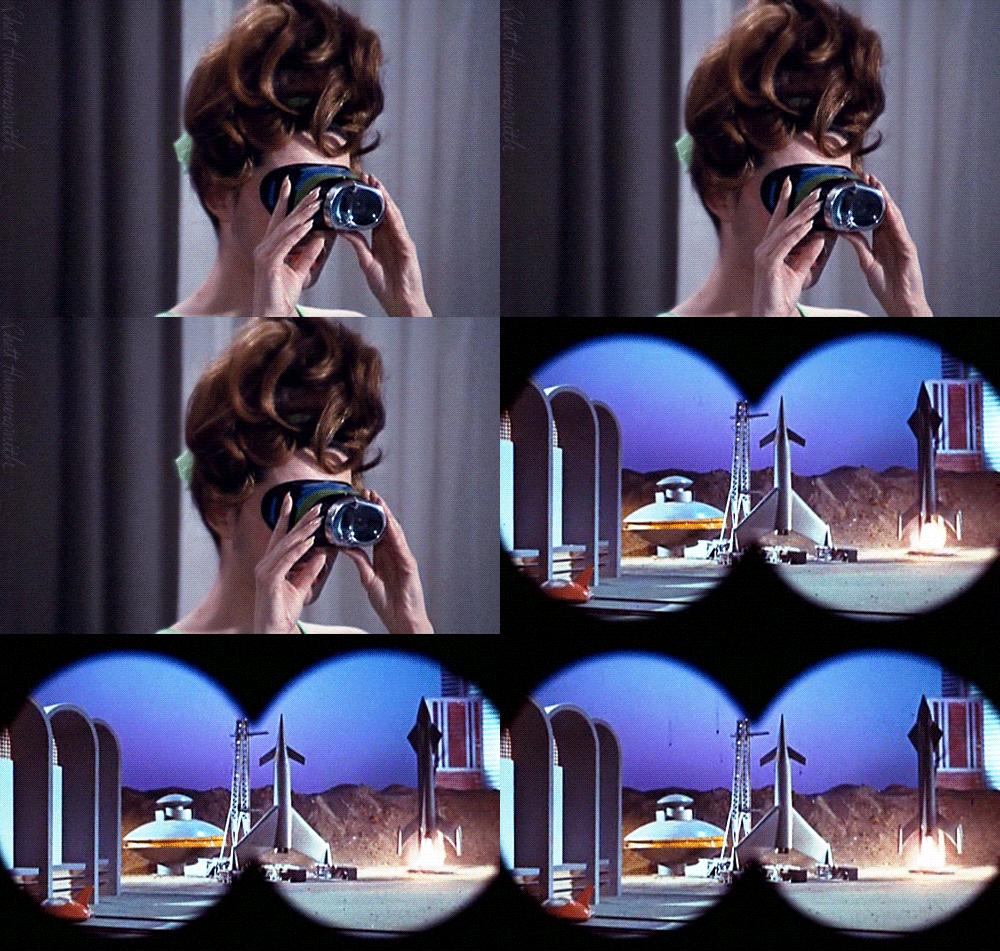
This reading made me think about how people’s ideas are formed and turned into a technological reality and how science is envloded in technology. The best example I can use to articlate my thought: A rocket Ship. A human with  the “idea or concept” to fly through the air into outer space to another planet. Throughout time and history they used science to create technology  that will help build a rocket that can go to the moon. Even allow humans to walk on the moon without exploding, to me that’s bring’s their idea too life to life.


Media and Technology

Giphy.com

Alassane Diop Week #6

I have read a article titled “Race In/For Cyberspace: Identity Tourism and Racial Passing on the Internet” by Lisa Nakamura. While I was reading the article I thought about numerous topics that were brought up. One big one was the meme of a dog that pretends to be a human while browsing the internet. It speaks on the idea that anyone that you may get in contact with online could be dog as ridiculous as it sounds. The notion is the internet can hid your physical self from the rest of the world and you can be what ever person you want to be. The internet is one of the greatest forms of self impression due to you being able to portray any character you want.  In Online MMO games you can pick your online physical form and change your gender, nationality, or even species.

The articles also made me think about the idea of us humans being about to change our physical appearance in real life. Not just body modifications like adding silicon or wearing a wig. But maybe changing your genes to make yourself taller or give your self a different eye color. We gave that to an extent nowadays with the possibility to change DNA for babies. The process is called designer babies. As cool as it may sound it brings up ethical and moral concerns. Critics of the project say it messes up how nature intends for humans to naturally be and how it may effect children later on in life.

Milagros’ Illustrate Wikipedia 10/1

I decided to add a picture to my high school’s wikipedia page. I had a photo of my high school in my camera roll and I was hoping that there wasn’t a photo so that I could easily just add a picture of my own to it. Luckily, nobody had added a photo so I decided to upload the photo of the front of the school. I think we choose photos to accompany descriptions based on what it is and how can it relate to the description. For instance, a description of a Starbucks coffee can be accompanied by a picture of a Starbucks’ coffee because that it was it is describing. I think pictures add the real part to something because its one thing to just read about something, but its another thing to see it for yourself. I decided to add a photo of the front of the school because I think that seeing the school gives the page more character and shows the readers know what the school looks like. I chose to represent the beginning part of the page, basically the introduction. I chose this part of the article because I noticed that it did not have a photo and that is the first thing that people see when they look up this article. I think that if there is a photo in the beginning, then people will be more interested in reading about this certain thing and have an image in their mind related to this certain thing.

Anthony Dyce Blog Post 10/1

For this week’s blog post, I decided to respond to Brian Winston’s “Media Technology and Society: A History from the Telegraph to the Internet”, which I found to be interesting because it explains how technology changed us. Winston writes the technology development of new media forms, from the telegraph and the telephone to computers, satellite and virtual reality, it follows a pattern. Winston provide examples of ways in which technology, human behavior and society are interconnected. Technology has been very beneficial, but it made us lazy as people. We tend to rally and depend on the use of technology. It makes our lives easy and comfortable. Technology has reduced our physical activity which is making us lazy.
Winston states “such an historical consciousness reveals the ‘Informative Revolution’ to be largely an illusion, a rhetorical gambit and an expression of technological ignorance” (Winston, 4). This quote stands out because it shows the way people are using technology it is hindering our knowledge. For instance, we no longer need to carry books if we don’t want to. Smartphones, tablets, and e-readers have made it easier for us to carry our books around without breaking our backs.

Works Citied
Winston, B. (2006). Media Technology and Society: A History: From the Telegraph to the Internet. London: Routledge.

Frida Barolli Week #6

For this weeks blog post I will be focusing on Lisa Nakamuras Race In/For Cyberspace. This article basically talks about social media and how people “label” themselves when they sign up for group chats or different social medias. How people describe themselves, their gender, birthdays, the way they write is all classified by race whether your black, white, Spanish, Asian etc. You can literally be talking to anyone and it could all be a lie. People of all races and genders are basically stereotyped. People create there own identities based on who they want the world to know, this person can basically “catfish” you. My younger sister was harrased on social media by a man who presented himself as a women on social media. The person had a profile that made you believe they were very social and active, had mutual friends. When people started noticing weird activity they began reporting him and they blocked the persons account. People create fake profiles for many different reasons, it can be to fool people, to just follow people, to harras, to just to active, there are many different reasons.

Lisa Nakamura, “Race In/For Cyberspace: Identity Tourism and Racial Passing on the Internet” in Works and Days, Volume 13, 181-193, 1995

week 6_StClair

In this week’s post,  I will discuss Lisa Nakamura’s article,  “Race In/For Cyberspace: Identity Tourism and Racial Passing on the Internet”. In this article, she begins with talking about a dog that is pretending to be a human on the Internet. This may be a silly cartoon, however, it speaks volume about the kind of people that are willing to lie and deceive others for their own amusement. Nakamura explains this by writing “The technology of the Internet offers its participants unprecedented possibilities for communicating with each other in real time, and for controlling the conditions of their own self-representations in ways impossible in face to face interaction(Nakamura, 1995). She is proving my point that people use the internet in any way they can and that people sometimes will use it to their advantage to manipulate and put on a facade in front of others. For example, this show “Catfish” explains how this is done. People pretend to be other people online and get into relationships with people for years although they are lying about who they actually are. The show continues on with the “catfish” being exposed for their lies. This is a modern example of Lisa Nakamura’s quote about how the internet provides opportunities for people to lie about themselves.

Lisa Nakamura, “Race In/For Cyberspace: Identity Tourism and Racial Passing on the Internet” in Works and Days, Volume 13, 181-193, 1995


Anthony Sierra Week #6 Blog Post

For this weeks blog post, I’ve decided to reflect on Lisa Nakamura’s “Race In/For Cyberspace: Identity Tourism and Racial Passing on the Internet.” This reading dives in depth on how people are able to change or alter their identities online in ways that they seem fit. “The technology of the internet offers its participants unprecedented possibilities for communicating with each other in real time, and for controlling the conditions of their own self-representations in ways impossible for face to face interaction (Nakamura 1).” This quote stands out because it shows how people are able to change the way they are represented in ways that is not possible to do physically.  In present day society, this revolves around the use of social media and how we have the ability to create a whole different persona. This may seem like an escape from reality for some, but majority has used this as to “Catfish” others.

Work cited

  • Lisa Nakamura, “Race In/For Cyberspace: Identity Tourism and Racial Passing on the Internet” in Works and Days, Volume 13, 181-193, 1995

“MACHINES” – WEEK 6 REFLECTION BY VICTOR AFOLABI

“For years inventions have extended man’s physical powers rather than the powers of his mind.” -EDITOR

Innovation by imagination
Selection process ~ Signs of Usefulness 
Plant the Idea
The lengths the invention takes man

“It has provided a record of ideas and has enabled man to manipulate and to make extracts from that record so that knowledge evolves and endures throughout the life of a race rather than that of an individual.” -Bush

These images represent what I believe to be the scientific principles of innovation from reading the “As We May Think” article. The procedure is also relevant in art as, “The Greeks knew only two procedures of technically reproducing works of art: founding and stamping…The woodcut graphic art became mechanically reproducible for the first time, long before script became reproducible by print.” (Benjamin, 1).

This quote shows the limitations time and space has on procedure for innovation as said in the Benjamin article. I believe there will always be new inventions in the future and we are just as amused with our computers today as the Greeks were amused with a new method to printing via wood cut graphic art. Although the times and spaces of the Greeks and our modern era were different, the methodologies to finding new means of innovation were the same.

Abby Potashnik-Blog Post #5

For this weeks’ blog post, I am responding to Brian Winstons’ “Introduction”. Brian chooses to touch upon the subject of how technology and humans relate to one another, and how the progress and production of technology changes and how it benefits us, as mankind. As technological production happens, we have to be careful to maintain its inferior position to humans. Yes, technology has its perks and is definitely beneficial,  but we do not want technology becoming the next superior artificial intelligence corporation taking us over. Seems a bit extreme, but that is how my favorite movie of all time started, The Terminator. We must appreciate where technology ideas began, its’ production, its’ continuous progression, its overall history in the past, its education in the present, and its potential in the future, but at a cost of caution.

In his work, Winston says “It is my contention that the received understanding of our current technological situation the view that we are living in the midst of an “Information Revolution” or at the start of an “Information Age” can be seen rather diffrently if the histories of the technologies involved are considered.” I could not agree more. We all have different ideas or thoughts on how technology is with us, how it is helpful or harmful. Either way, our job is to be on top of it and be helpful to ourselves and one another.