
For week #7 I will be refelcting on “Email, The Letter, And The Post” by Mark Nunes. This article was basically about how writing letters turned into sending emails. We think that sending an email is just opening the computer logging into your email and typing away, what we dont understand is the process in which it takes to send the email.” The sender composes a message using the email client on their computer. When the user sends the message, the email text and attachments are uploaded to the SMTP (Simple Mail Transfer Protocol) server as outgoing mail. All outgoing messages wait in the outgoing mail queue while the SMTP server communicates with the DNS (Domain Name Server–like a phone book for domain names and server IP addresses) to find out where the recipient’s email server is located. If the SMTP server finds the recipient’s email server, it will transfer the message and attachments. If the recipient’s server can’t be found, the sender will get a “Mail Failure” notification in their inbox. The next time the recipient clicks “Send & Receive,” their email client will download all new messages from their own email server. You’ve got mail!” All of this work does not compare to actually hand writting a letter. I remember when I was in 4th grade and I had to write a letter to a penpal. I thought it was the most amazing experience ever. I got to write a thoughtful message with my own hand writting and then draw pictures around it to show how excited I was to meet my pal. I believe it is more thoughtful when you take the time to write something out in a letter rather then an email.
Carolyn Pena Blog Post Week #7
In “Email, Letters, Post” Mark Nunes writes about the concept of writing an email and a letter. As I was reading, one quote that stood out to me was “The traditional post treats the letter as a material singularity, one that (hopefully) remains passive in its transport from point of dispatch to point of destination. It assumes, and asks its users to assume, that the letter maintains its integrity, neither mutilated nor unsealed during its journey from A to B”. I read this out loud and my little cousin asked me “How do you send out a letter?” I looked at her as if she was joking but she wasn’t. My cousin is in the 4th grade and she was never taught how to send a letter but she knows how to send an email. Although this might not be a big deal, I found it so interesting because back then I was only taught how to write a letter and now she was just taught how to send out an email. This quote that was mentioned before writes about how the person who received the letter expects that what was written in the letter is still true. Back then the whole process of sending out a letter would take much longer than it does now. I also think that sending out letters is very rare now because of the majority people that use email as communicating with one another since it is instant. One thing that hasn’t changed about letters and emails all these years is that once it is sent out, there is no way to unsend it nor change what was already sent.
Nunes, Mark. “The Email, The Letter, and The Post.” from Cyberspaces of Everyday Life. University of Minnesota Press, 2006.
Blog Post Week 8 Anesiya Rivera
We don’t ever think too much in how an email is constructed today. We focus on just sending it out and receiving. Not understanding how the concept of emailing came about. The thought of transporting communication through a telegraph and through out time turning telegraphs into emails. Understand that your able to construct an email in personally and professionally and the person on the other end can receive it instantly and have an option to reconstruct your message on their end.
It started with a thought/Idea
Someone idea turned into a physical form of communication
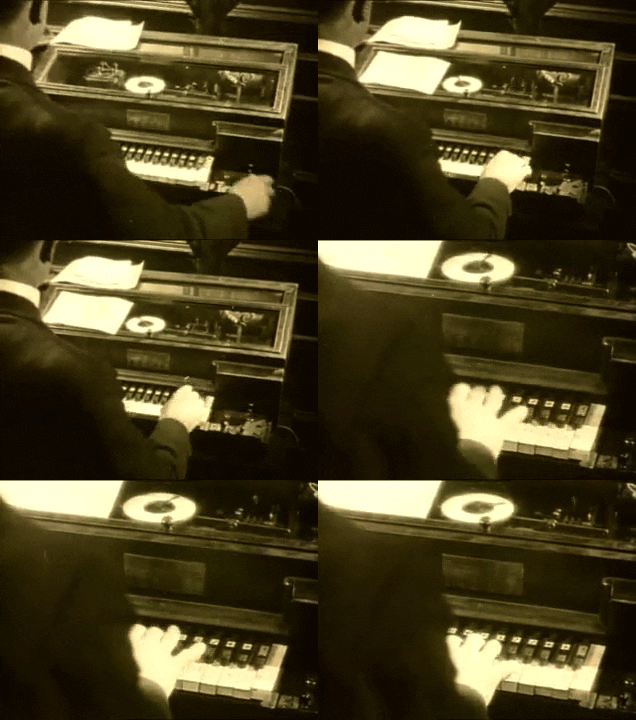
a physical form of communication turned into a virtual idea / concept for communication


The idea of Society not being able to function without email today is hilarious. We work off of emails, School emails, Personal Emails, Entertainment emails, Spam emails, We even need our emails to get discounts ! It’s a concept that allows to us to function.
Website: Giphy.com https://giphy.com/gifs/bublywater-neil-patrick-harris-email-1APaaUc09xFSGHXECL/links
Alassane Diop Week 7
While I was reading “The Coming of the Microcomputer”, I thought of the change computers have gone through over the years. Back in the 1950’s computer were gigantic. They took up tons of space that could fill an entire room. All these computers can do is simple math equations similar to what our calculators do nowadays. Information must also be transferred manually unlike modern technology.
Today the technology evolved to something more smaller and more compact. Which are our smartphones, a product of modern technology which to the eyes of those living decades ago seems like a dream. I currently own the iPhone 6s Plus which came out a few years ago so it has less power than the latest iPhone, but it is significantly more powerful than the room-sized computers of the 1950’s. In terms of tech, we have developed so much in half a century.
Our phones now are not just pocket computers but also cameras, mobile phones, and provides different ways to communicate.

Abby Potashnik- Blog Post #7
For this week’s blog post, I chose to write about Mark Nunes’ “Email, Post, Letters”. I enjoyed reading this chapter because Nunes focuses on many things that attribute to the technological side of mail and what that entails. When we send an email, we don’t think of much when we type it, when we send it, and when we recieve a response. There was so much that went into the construction of faster mail delivery, that it became what we know as all sorts of different forms of mail. Letters, post, delivery, mail they are all such awesome and complicated services that have been progressing for our “well-being”. The amount of number associated with daily deliveries is mind boggling. The amount our world had progressed from snail mail or no mail at all, depending on your geographical location, we have come so far. These words highlighted for me, how far our world, and our societies have come, what progress we have made in all ways. Technological, biological, and even subcategories of just those areas of lie or so rich and filled what information, data, and onward and upward movement. That concept is awesome to think about, to know that if we apply mail and delivery progression, imagine so much more how much the world progressed in other departments, e.g. the Indsutrial Era, to name one.
Anthony Dyce 10-8-18 Blog Post
For this week’s blog post, I decided to respond to Ted Nelson “Literary Machines Part 1” which I found to be very interesting because he invented the word “hypertext” which is something I frequently used all the time. Nelson states “some people like all this incompatibility and complication, and say it is the new world we must learn to live in. Others, already hating computers, correctly dread these matters and hope vainly to stop the computer tide.” (Nelson, 14) When I read this quote it made me think about how people hate iPhones and you have others that hate Androids. Both devices do the same thing. Preferably, you have people that buy the newest iPhones or newest Androids. For some reason, we feel like it’s necessary to buy because we can feel like were being left out on the newest device. For example, I recently brought a new iPhone because of the newest features. Computers and technology shape our lives. The truth is we all rely on technology a great deal to get through the day. Whether it’s at work, at home, or at school we depend on computers and technology greatly. However, it may be not a good thing because life would be different without technology in our lives.
Work Citied
Ted Nelson, Literary Machines Part 1
Jailene Mangome, Blog post 6
This week I decided to reflect on Brian Winston’s “The Coming of the Microcomputer”. While reading this I couldn’t help but think about how far we’ve come with technology and how much it has expanded through time. These “minicomputers” have taken over the globe. Before while people were continuously trying to make these computers smaller, faster, and better, they were just going off of how quickly the invention was made; but now we carry these quickly developed and tiny computers everywhere we go. On the very first page of this text, Winston quotes Augarten saying “For the first two decades of the existence of the high speed computer machines were so scarce and so expensive that man approached the computer the way an ancient Greek approached an oracle”. (p. 12) I found this quote so interesting because I feel like this is exactly how we act when a brand new iPhone or Samsung Galaxy is coming out. As if it were a god put on this earth. It’s such a precious and expensive object that we want it right away and we just have to have it. The only difference is that we jump on these brand new products while before they didn’t. However we treat these objects with such care that the smallest thing may happen to it and we go absolutely bonkers- mostly because if we drop it and it breaks we die a bit on these inside because we know just how expensive these phones are. Computers have been developing in itself for so long and now we have things like iPads, laptops, tablets, Smartphones that we can’t seem to live without now, etc. Technology by the day is growing more and more and we can’t seem to get enough of it. The world has become so digitalized that we even forget how to do things without it. Myself included.
Clary Capellan, Week # 7, 10/6
For this week’s blog post I’d like to talk about the “Microcomputer” reading by Brian Winston. One quote that I believe illustrates the evolution of the print culture to computer technology is when Winston states”The home computer became the personal computer, which , while it could exist in the home, also had a function as a tool in the workplace. It was only with the coming of accessible word-processing, which turned the home PC into a very effective typewriter, and the arrival of the modem which permitted email and Internet access that meaningful domestics were found.” In other words, the introduction of the home computer substituted the typewriter as a result of the new found word-processor, which would make typing printed documents efficient and convenient. This signifies how the invention of the home computer met societies need which in fact lead to it’s ever so present revolution.
Reference:
Winston, Brian. “The Coming of the Microcomputer.”
Abby Potashnik- Blog Post #6
For this week’s post, I chose to respond to Ted Nelson’s Literary Machines. I left the reading with a load of spiraling thoughts, and focused to write about the progessiveness of Ted Nelson’s Project Xanadu. Project Xanadu was Nelson’s way of eventually improving the World Wide Web and created the first hypertext project. It’s purpose of creation was similar to the purpose of creation of the Printing Press. To benefit mankind in many, many ways, to better science, to better education, etc. I enjoyed reading Nelson’s work because I I chose to look and how astonishing and formidable, the progression of putting text on to a computing technological level is. It’s facsinating when you read up on the work of a trailblazer. You see how much time and effort they put in, what their goals are, what they hope their creation will achieve for mankind and society. It inspires you, or me, to go out there and contribute to society in a productive way. To benefit mankind, to make us greater, and better, and live lives we are proud and happy living.
Jailene Mangome, blog post #5
This week I chose to read “How We Become Posthuman” by N. Katherine Hayles. While reading this is felt a bit confused the entire time because of the wording in it. I kept finding myself having to stop reading and looking up a word to get the meaning of it so the text could make a little more sense. No matter how many times I read this, nothing was clicking for me and I kept thinking to myself, “Maybe I should just read a different article,” but i couldn’t bring myself to. Every time I would reread the text, I’d think I was understanding it, but then i would get t the next page and be completely confused and angry again. In the first page of the article, Hayles explains Turning’s test and says our responsibility is to form questions that we can decipher the difference between the “he/she/it” , the “intelligent machine” and the “intelligent human” or the male and female. “By including gender, Turning implied that renegotiating the boundary between human and machine would involve more than transforming the question of “who can think” into “what can think.””What I was getting from this is that Turning felt that there was a connection between identifying the machines from the humans and trying to test people on which was human( male or female) and which was the machine. It was to test someone’s intelligence on this matter. Reading this test was completely challenging and i wanted to go against it, but the text won.

