
This week I chose to read “How We Become Posthuman” by N. Katherine Hayles. While reading this is felt a bit confused the entire time because of the wording in it. I kept finding myself having to stop reading and looking up a word to get the meaning of it so the text could make a little more sense. No matter how many times I read this, nothing was clicking for me and I kept thinking to myself, “Maybe I should just read a different article,” but i couldn’t bring myself to. Every time I would reread the text, I’d think I was understanding it, but then i would get t the next page and be completely confused and angry again. In the first page of the article, Hayles explains Turning’s test and says our responsibility is to form questions that we can decipher the difference between the “he/she/it” , the “intelligent machine” and the “intelligent human” or the male and female. “By including gender, Turning implied that renegotiating the boundary between human and machine would involve more than transforming the question of “who can think” into “what can think.””What I was getting from this is that Turning felt that there was a connection between identifying the machines from the humans and trying to test people on which was human( male or female) and which was the machine. It was to test someone’s intelligence on this matter. Reading this test was completely challenging and i wanted to go against it, but the text won.
Anesiya Rivera Week 7
As we read further about how technology has advanced and became part of society’s everyday living, the reading looks at how technology should be organized or how the information on technology is organized, the way I look at this is the iPhone for example, an ever advancing device. That stores our everyday information. We have hundreds of apps that allow us to organize our time, scheduled our events , travel, communicate with others, shop online and now i store with Apple Pay. We literally have our whole lives stored in one device. Our bank accounts doctor appointments, even our work. As I think more into it, we HAVE to even pay for more storage ! For our music pictures, documents the more we need to store the more we have to pay !
Giphy.com
chapter two proposal for universal electronic publishing


Anesiya Rivera Week 6
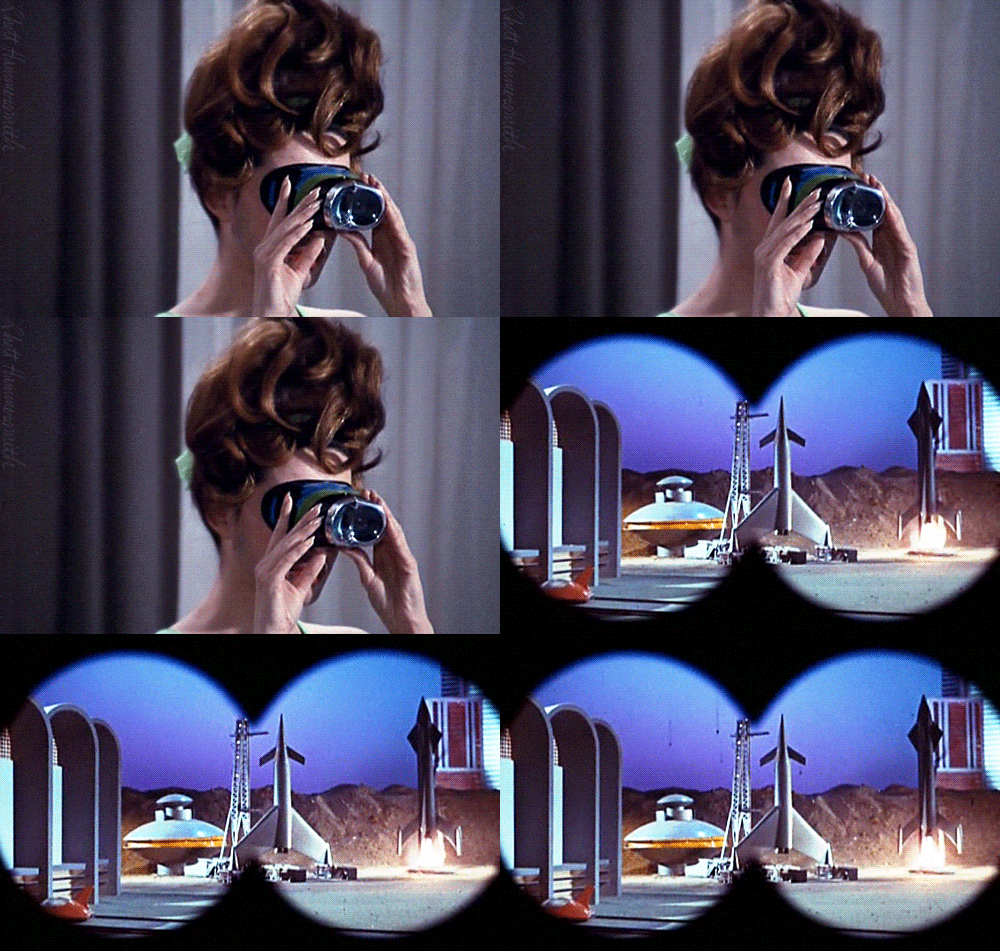
This reading made me think about how people’s ideas are formed and turned into a technological reality and how science is envloded in technology. The best example I can use to articlate my thought: A rocket Ship. A human with the “idea or concept” to fly through the air into outer space to another planet. Throughout time and history they used science to create technology that will help build a rocket that can go to the moon. Even allow humans to walk on the moon without exploding, to me that’s bring’s their idea too life to life.
Media and Technology
Giphy.com
Jessica Colasacco (Week 5)
This week, I decided to focus on “The Work of Art in the Age of Mechanical Reproduction” by Walter Benjamin. As someone who appreciates art, this article really caused me to think about authenticity of art. One of my favorite things is going to the Brooklyn Museum or MOMA and looking at a real Moet painting. But I also am a huge Andy Warhol fan, which made me question if I could truly appreciate the authenticity of art if I supported an artist who replicated art for a living. In this article, Benjamin states, “Replicas were made by pupils in practice of their craft, by masters for diffusing their works, and, finally, by third parties in the pursuit of gain”. If this was applied to Warhol, would that mean he was just using his art work in pursuit of gain instead of as a mean of expressing himself? Personally, I believe that his artwork was a way of expressing himself in a specific culture that allowed his work to be successful, but that is my own opinion and other people can think differently than I.
Sources:
Walter Benjamin, “The Work of Art in the Age of Mechanical Reproduction.” 1936.
Walter Benjamin // Miranda Pacheco (Week 5)
Walter Benjamin in “The Work of Art in the Age of Mechanical Reproduction” introduces the concept of authenticity. He speaks about an individuals desire to see the authentic nature of a piece of work then explains how reproduction has its own part in recreating this nature. Benjamin states, “the authenticity of a thing is the essence of all that is transmissible from its beginning ranging from its substantive duration to its testimony to the history which it has experienced” (Benjamin 4). When done correctly art that is reproduced is still able to tell the story of its beginning, its formation, and its place in history. I find this concept fascinating because I unintentionally look for the authentic nature in things all the time. I find art more credible when it’s attached to its origin story, even when its not exact to its original I appreciate the uniqueness of a replicated piece.
Explained in the reading authenticity of art is based on “ritual” (Benjamin 6), as Benjamin circles back to mechanical reproduction he points out that works of art are no longer dependent on rituals just mass production. This is important to note because now authenticity is viewed differently. In this day in age many people desire quantity and numbers, opposed to the process a piece went through in reproduction. One is not greater then the other, it’s a matter of preference and culture. In present day I, along with many others benefit from mechanical production with everything that’s being mass produced. This doesn’t change my enjoyment of art before mechanical reproduction. I’ve always found value in the one and even when reproduced the uniqueness is still present. One of my favorite examples is the architecture in Europe. So many buildings, with such rich history and even when buildings were recreated they still had a consistency with its origin.
CITE:
Benjamin, Walter. “The Work of Art in the Age of Mechanical Reproduction” from Illuminations. New York, Schocken Books, 1968.
Isaac Espinoza Blog Post 5
For this week I’ve decided to reflect on “Media, Technology, and society” by Brian Winston. Throughout the reading, Winston drives home the point that Western Civilization has not undergone this “information revolution”, but instead has slowly evolved into what it is today. He argues that our society did not change all at once when it comes to communication and technology but rather continuously and will continue to do so. Many people are blinded by the “storm” that is progress and tend to focus on the result rather than the process. We are so in awe of what we have accomplished that we forget how we even accomplished that in the first place. Take the current state of the cell phone for example. The cell phone has become a pocket computer in many ways. It allows us to communicate in ways we could have only dreamt of 10 years ago. It was only through continuous progress and innovation that we arrived at the cell phone that most of us have today.
Works Citied
Winston, B. (2006). Media Technology and Society: A History: From the Telegraph to the Internet. London: Routledge.
Alassane Diop Week #6
I have read a article titled “Race In/For Cyberspace: Identity Tourism and Racial Passing on the Internet” by Lisa Nakamura. While I was reading the article I thought about numerous topics that were brought up. One big one was the meme of a dog that pretends to be a human while browsing the internet. It speaks on the idea that anyone that you may get in contact with online could be dog as ridiculous as it sounds. The notion is the internet can hid your physical self from the rest of the world and you can be what ever person you want to be. The internet is one of the greatest forms of self impression due to you being able to portray any character you want. In Online MMO games you can pick your online physical form and change your gender, nationality, or even species.
The articles also made me think about the idea of us humans being about to change our physical appearance in real life. Not just body modifications like adding silicon or wearing a wig. But maybe changing your genes to make yourself taller or give your self a different eye color. We gave that to an extent nowadays with the possibility to change DNA for babies. The process is called designer babies. As cool as it may sound it brings up ethical and moral concerns. Critics of the project say it messes up how nature intends for humans to naturally be and how it may effect children later on in life.
Milagros’ Illustrate Wikipedia 10/1
I decided to add a picture to my high school’s wikipedia page. I had a photo of my high school in my camera roll and I was hoping that there wasn’t a photo so that I could easily just add a picture of my own to it. Luckily, nobody had added a photo so I decided to upload the photo of the front of the school. I think we choose photos to accompany descriptions based on what it is and how can it relate to the description. For instance, a description of a Starbucks coffee can be accompanied by a picture of a Starbucks’ coffee because that it was it is describing. I think pictures add the real part to something because its one thing to just read about something, but its another thing to see it for yourself. I decided to add a photo of the front of the school because I think that seeing the school gives the page more character and shows the readers know what the school looks like. I chose to represent the beginning part of the page, basically the introduction. I chose this part of the article because I noticed that it did not have a photo and that is the first thing that people see when they look up this article. I think that if there is a photo in the beginning, then people will be more interested in reading about this certain thing and have an image in their mind related to this certain thing.
Carolyn Pena Blog Post Week #5
In this week’s blog post, I decided to write about “The Work of Art in the Age of Mechanical Reproduction” by Walter Benjamin. On page 3, Walter Benjamin wrote: “Even the most perfect reproduction of a work of art is lacking in one element: its presence in time and space, its unique existence at the place where it happens to be … This includes the changes which it may have suffered in physical condition over the years as well as the various changes in its ownership”. I like this quote a lot because I feel like this fails to cross a lot of peoples minds. We all know that art is unique and historical but what we don’t really think about is how it got where it is now. When we go to a museum, we are surrounded by so many pieces of art and right next to it will be a brief description of the piece of art. All of those pieces of art all ended up in the same museum but where were they before that? I also consider communication as a sense of art and the variety of changes there has been to communication throughout the years. This makes me think about the process of communication and how it ended up where it is now.
Walter Benjamin, The Work of Art in The Age of Mechanical Reproduction, 1936. German philosopher Benjamin’s aura
Anthony Dyce Blog Post 10/1
For this week’s blog post, I decided to respond to Brian Winston’s “Media Technology and Society: A History from the Telegraph to the Internet”, which I found to be interesting because it explains how technology changed us. Winston writes the technology development of new media forms, from the telegraph and the telephone to computers, satellite and virtual reality, it follows a pattern. Winston provide examples of ways in which technology, human behavior and society are interconnected. Technology has been very beneficial, but it made us lazy as people. We tend to rally and depend on the use of technology. It makes our lives easy and comfortable. Technology has reduced our physical activity which is making us lazy.
Winston states “such an historical consciousness reveals the ‘Informative Revolution’ to be largely an illusion, a rhetorical gambit and an expression of technological ignorance” (Winston, 4). This quote stands out because it shows the way people are using technology it is hindering our knowledge. For instance, we no longer need to carry books if we don’t want to. Smartphones, tablets, and e-readers have made it easier for us to carry our books around without breaking our backs.
Works Citied
Winston, B. (2006). Media Technology and Society: A History: From the Telegraph to the Internet. London: Routledge.

